
Hard Water and Arsenic in Goliad 77963 and Berclair 78107
White scale can tell you something about mineral hardness. It cannot tell you whether arsenic is present, and the answer changes depending on whether a home uses public water or a private well.
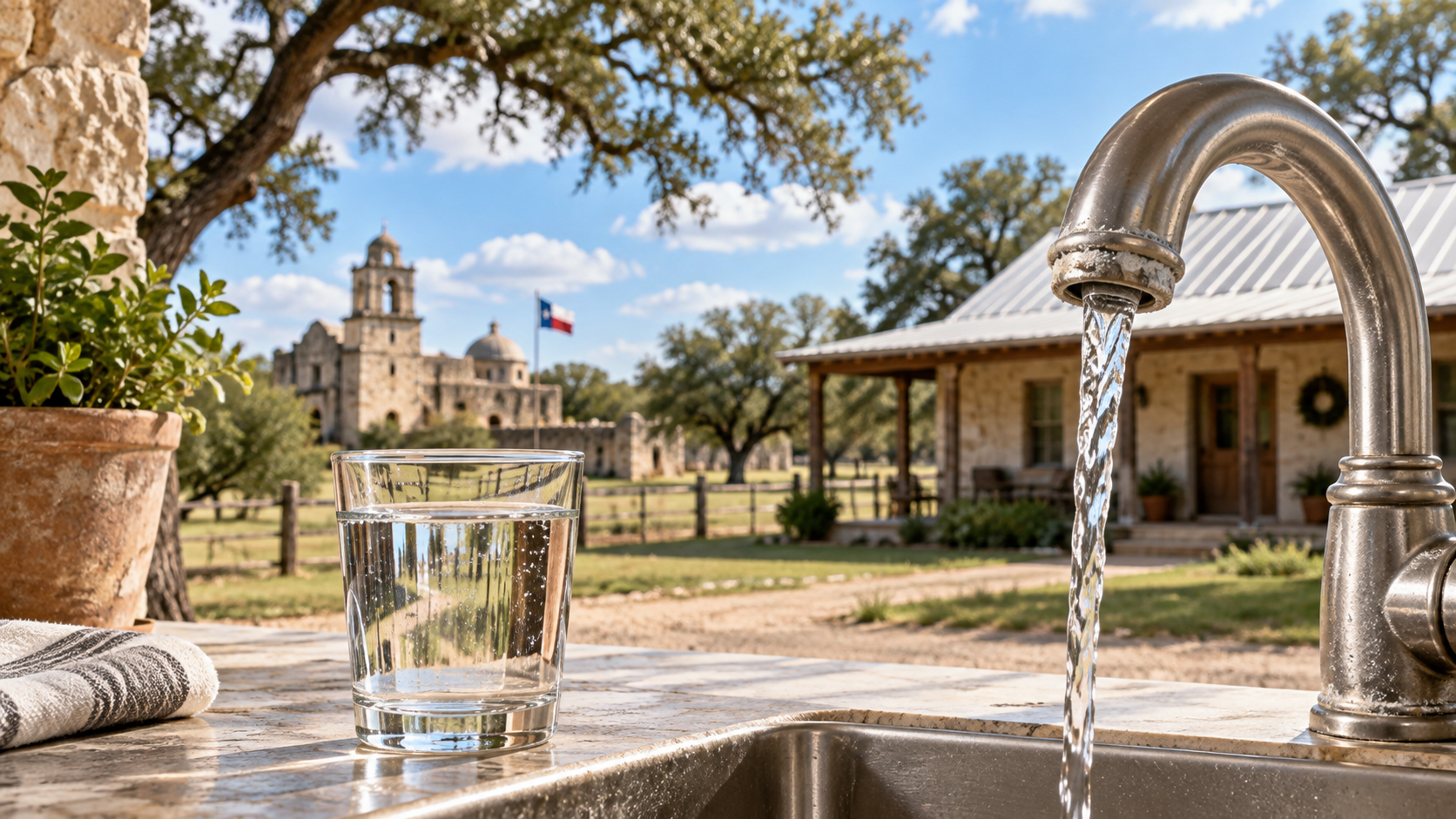
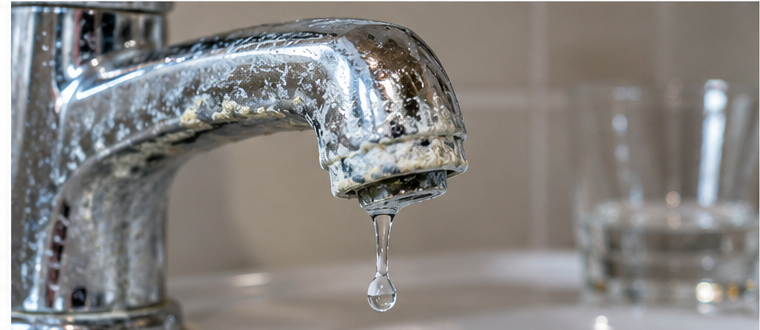
For homeowners in Goliad 77963 and Berclair 78107, white scale around faucets can raise a bigger question. Is hard water only a plumbing problem, or can it also point to a drinking-water concern?
The first step is separating two different issues.
Hard water is mainly caused by dissolved calcium and magnesium. It can leave limescale on faucets, build up inside water heaters and affect soap performance. Water hardness itself, however, is not considered the same type of health concern as a contaminant such as arsenic.
Hardness leaves clues
Calcium and magnesium can leave scale on fixtures and inside water heaters.
Arsenic is different
It is not identified by limescale, taste or a household hardness strip.
Source matters
A public-water customer and a private-well household should not use the same evidence.
Hard water and arsenic in water are different
Groundwater in Goliad County has a documented history of mineral hardness, making scale and water-heater buildup relevant household issues.
But arsenic in water is a separate question.
The City of Goliad’s 2024 Consumer Confidence Report recorded arsenic below the federal maximum contaminant level. That report applies to the city’s public water system, not every private well across the county.
Private wells require a different level of attention.
Research and groundwater monitoring in southern Goliad County have previously found elevated arsenic in some private wells. This matters for rural properties around Goliad and Berclair, where one home may use public water while another may rely on a private well.
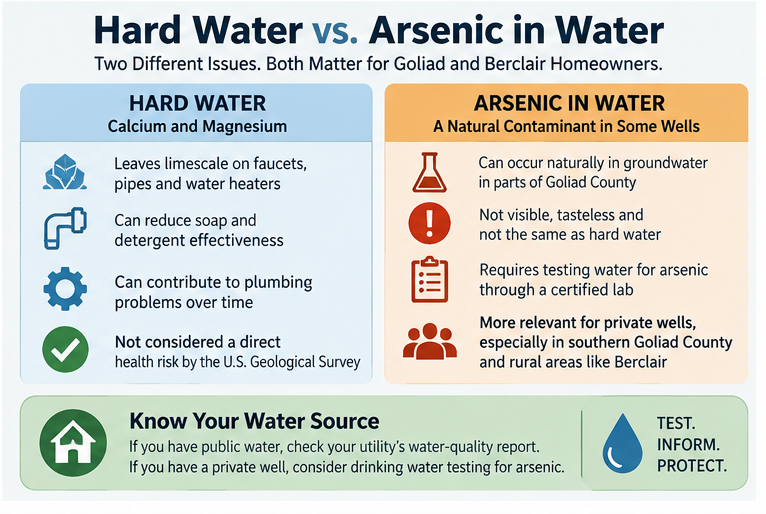
Hard water
Calcium and magnesium can leave limescale, affect soap performance and contribute to plumbing buildup.
Arsenic in water
It is a separate contaminant question. Limescale does not show whether it is present, and testing is required for a private well.
Know the water source
Public water starts with the utility report. Private wells depend on the testing history of the individual well.
Limescale cannot tell you whether arsenic is present
Visible scale mainly reflects minerals such as calcium and magnesium.
It does not show whether arsenic is present.
A homeowner can therefore have hard water without an arsenic problem, or have arsenic in well water without seeing any obvious warning from the faucet.
That is why testing water for arsenic requires an appropriate laboratory or water-quality test rather than a hardness strip or visual inspection.
For private-well households, drinking water testing for arsenic can be especially useful when there is no public utility report covering the property.
Public water and private wells should be treated differently
If your home is connected to a public water system, start with the utility’s current water-quality report.
If the property uses a private well, the testing history of that individual well matters more.
A water softener may help reduce calcium and magnesium and control scale, but it should not automatically be assumed to remove arsenic.
For homeowners in Goliad 77963 and Berclair 78107, the most useful first question is simple.
Where does your water come from?
That answer determines whether you should be thinking mainly about hard-water plumbing problems, reviewing a public water report, or considering private-well testing.
Check the current report
Use the water-quality report from the utility that actually serves the property. Do not use a private-well finding as a substitute for a public-system report.
Use well-specific testing
Consider appropriate laboratory testing when the question is arsenic. Hardness strips and visible scale answer a different question.
Source notes
Content hierarchy: Plumbing → Texas → Local Explainers. The article URL remains shallow even though the navigation hierarchy is deep.