
Horizon City Water Quality What the Consumer Confidence Report Tells You and What It Does Not
A measured local explainer on Horizon City water, Horizon City tap water, the Horizon Regional MUD water quality report, drinking water hardness, tap water contaminants, and what can change inside an individual home.

Water is one of the most familiar parts of daily life. We turn on a faucet and expect clean water to appear within seconds. Yet, the journey behind that glass of water is far more complex than most homeowners ever see.
For anyone trying to understand Horizon City water, the first question is often simple: where does it come from, and what happens before it reaches the tap?
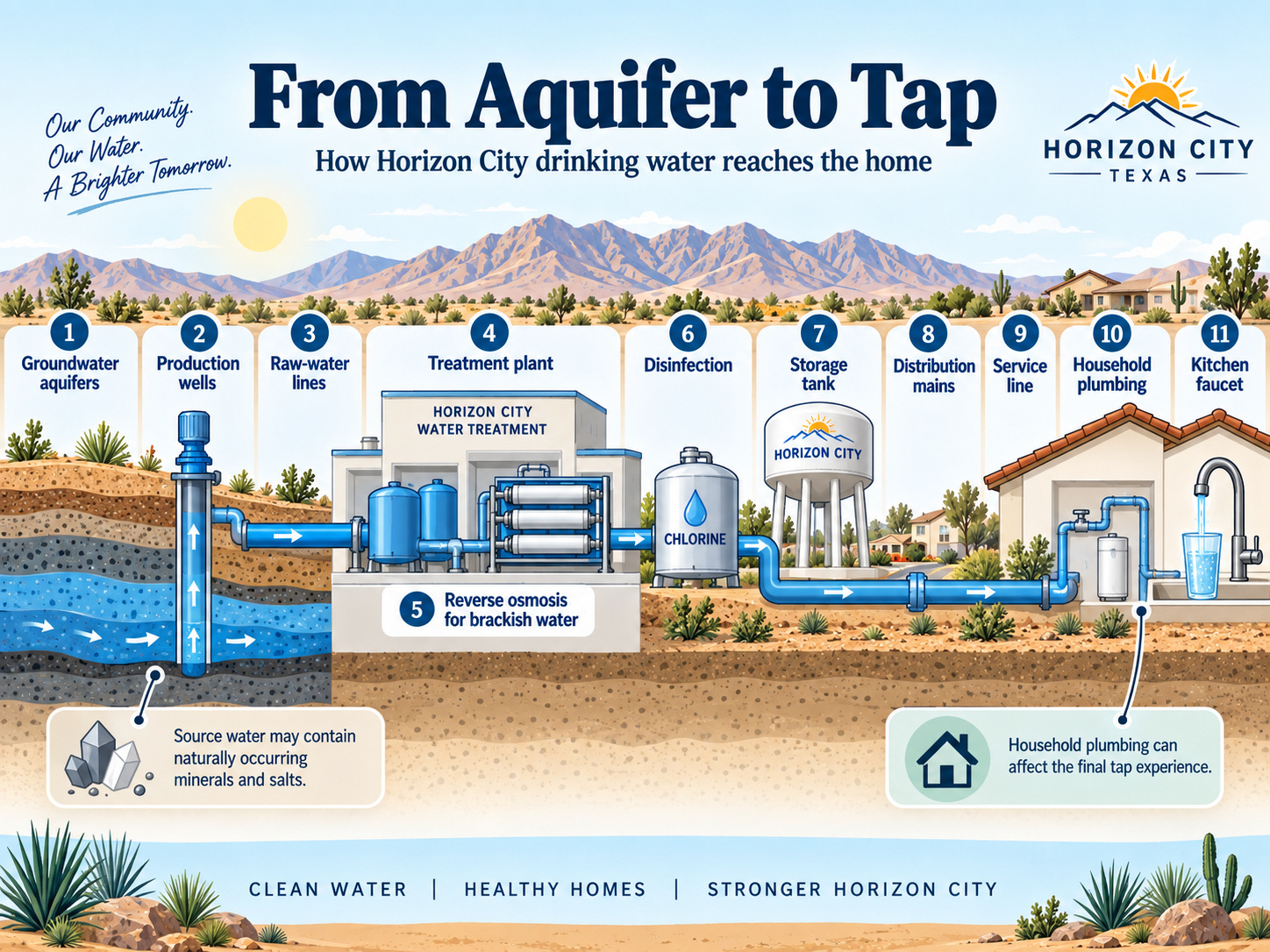
In Horizon City, drinking water passes through groundwater sources, wells, treatment systems, storage facilities, distribution lines, service connections, and finally the plumbing inside individual homes.
This is why Horizon City water quality, Horizon City tap water, and drinking-water hardness should not be treated as the same issue.
Clear water can meet drinking-water standards and still contain naturally occurring minerals or regulated substances at permitted levels. The condition of an individual home’s plumbing can also influence what eventually comes out of the faucet.
Source
Groundwater and brackish-water treatment context.
2024 report
Official Consumer Confidence Report findings.
Hardness
No current citywide hardness figure in the latest CCR.
Your home
Household plumbing can change the final tap experience.
On this page
Where Horizon City water comes from
Horizon Regional Municipal Utility District reports that its drinking water comes from groundwater associated with the Hueco-Mesilla Bolson aquifers. The district also uses brackish groundwater that requires treatment before it can be distributed as drinking water.
Regional geological studies show that groundwater in the wider El Paso area occurs at different depths depending on location and aquifer conditions. Rio Grande alluvial formations can be relatively shallow, while water-bearing formations within the Hueco Bolson system may extend considerably deeper.
These regional geological figures should not, however, be treated as the confirmed depth of every active Horizon Regional MUD well without individual production-well records.
What matters for homeowners is that the water begins underground.
As groundwater moves through soil, sediment, sand, gravel, and rock, it may naturally dissolve minerals, salts, metals, and other substances. Those naturally occurring constituents become part of the raw water long before it reaches a treatment facility.
From aquifer to Horizon City tap water
The process does not end when groundwater is pumped from a well.
Water first moves through raw-water infrastructure toward treatment facilities. Horizon Regional MUD states that its reverse osmosis plant treats brackish groundwater through filtration processes.
The district has reported that water drawn from some wells near Interstate 10 historically emerged with approximately 1,600 to 1,700 milligrams per liter of total dissolved solids, with levels typically reduced after reverse osmosis treatment.
After treatment and disinfection, water moves into storage facilities and then into the distribution system.
From there, it travels through underground water mains, enters individual properties through service lines, and finally passes through household plumbing before reaching the faucet.
That final part of the journey is important.
The quality of water leaving the public system and the condition of water experienced at a particular household tap are connected, but they are not necessarily identical.
What the Horizon Regional MUD water quality report found
The most useful official starting point for examining Horizon Regional MUD water quality is the district’s annual Consumer Confidence Report.
A Consumer Confidence Report, sometimes searched for simply as a water quality report, provides information about drinking-water sources, regulated contaminants, monitoring results, and compliance with applicable drinking-water standards.
Horizon Regional MUD’s 2024 Drinking Water Quality Report detected several regulated substances.
Arsenic was reported at 1.8 parts per billion, compared with a federal maximum contaminant level of 10.
Nitrate was reported at 0.61 parts per million, compared with a limit of 10.
Fluoride was measured at 0.26 parts per million, compared with a limit of 4.
The report also recorded haloacetic acids at an average of 4.13 parts per billion and total trihalomethanes at 34.27 parts per billion.
Chlorine residual averaged 1.79 parts per million.
Selected 2024 Consumer Confidence Report results
According to the Consumer Confidence Report, these regulated detections were within the applicable standards reported for the system.
The report also identified lithium through the EPA’s Unregulated Contaminant Monitoring Rule programme. The average detected concentration was 71.8 micrograms per liter.
That number requires careful interpretation.
Lithium does not currently have the same type of federal maximum contaminant level as regulated substances such as arsenic or nitrate. Its detection therefore should not be presented as evidence that Horizon Regional MUD violated a drinking-water standard.
Can clear water still contain tap water contaminants?
Yes.
Drinking water does not need to be chemically empty in order to meet drinking-water standards.
Horizon Regional MUD’s own report explains that drinking water may reasonably contain small amounts of contaminants or naturally occurring substances, and that the presence of a substance does not automatically mean the water presents a health risk.
This distinction is important when people search for tap water contaminants.
A laboratory may detect a substance at a very small concentration while the measured level remains below the regulatory threshold established for that contaminant.
Groundwater can also contain naturally occurring minerals.
The district notes that constituents such as calcium, sodium, and iron may affect taste, appearance, or odor. These are treated differently from contaminants regulated primarily for health protection.
So, clear water may still contain measurable substances.
What was detected, at what concentration, how it compares with the applicable standard, and whether that measurement represents the water system or one particular property?
What about drinking water hardness?
This is where discussions about drinking water hardness can become confusing.
Hard water is primarily related to dissolved minerals, particularly calcium and magnesium. It is not automatically the same thing as unsafe water.
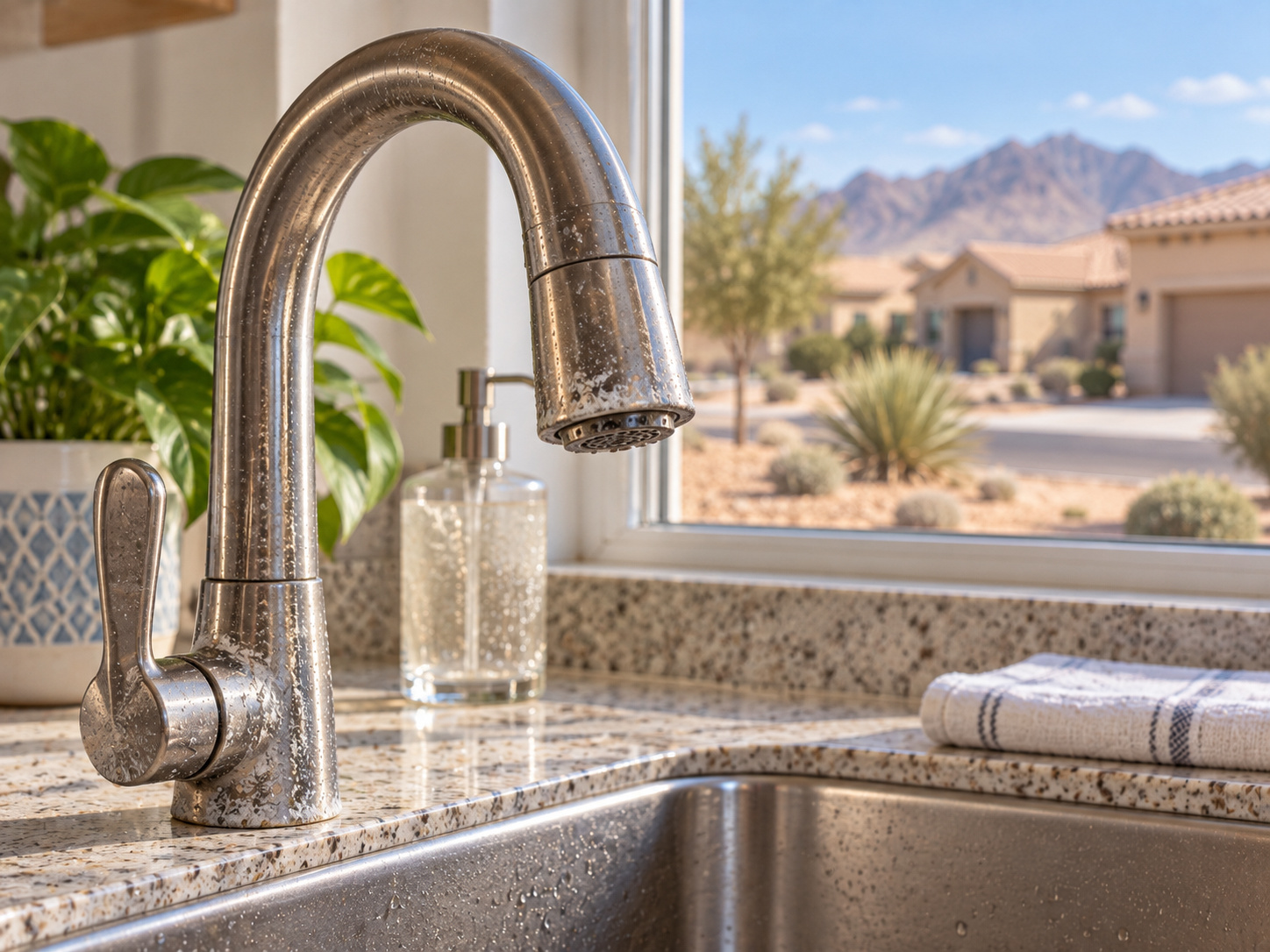
Mineral deposits around faucets, showerheads, glassware, or fixtures may indicate mineral-rich water.
However, Horizon Regional MUD’s latest Consumer Confidence Report does not provide a current citywide hardness figure.
For that reason, the statement that “Horizon City has hard water” needs context.
Historical testing or individual household observations may suggest mineral-related conditions, but they should not be presented as a current hardness measurement for every property served by the system.
Water quality by ZIP code what 79928 can and cannot tell you
Residents frequently search for water quality by ZIP code, including 79928 water quality.
That can be useful as a starting point, but ZIP codes and water-system boundaries are not necessarily the same thing.
A ZIP code may contain properties served by different utilities or water systems. For that reason, a homeowner should identify the actual water provider serving the property before assuming that one report represents every address within ZIP code 79928.
For homes served by Horizon Regional MUD, the district’s own Consumer Confidence Report is a more appropriate source than a generic ZIP-code database.
Even then, the report describes the public water system. It cannot fully describe what happens after water enters an individual property’s service line and internal plumbing.
Use the Horizon City hub to confirm provider and geography context →
The condition of the home also matters
Water leaving a treatment facility is only part of the story.
Service lines, household pipes, fixtures, corrosion, periods of stagnation, and the age and condition of plumbing can influence what eventually comes from an individual faucet.
Horizon Regional MUD’s Consumer Confidence Report specifically notes that lead, where present, can originate from service lines and household plumbing.
The district also states that some service-line materials in its inventory remain classified as unknown.
This means that a utility-wide report cannot fully describe conditions inside every individual property.
Two Horizon-area residents shared experiences that raise this household-level question.
One resident described a particular home, reported to have been built before 2014, where occupants experienced episodes of stomach discomfort and diarrhea. According to the resident, the problem appeared to stop after plumbing issues within the property were addressed.
A second resident described recurring concerns before plumbing work was carried out at another home. The resident recalled that the Horizon City tap water sometimes had an unusual taste and, on a few occasions, appeared slightly different in color. According to the resident, those concerns reduced after the plumbing was repaired.
These accounts have not been independently verified.
They do not establish that Horizon Regional MUD water caused the symptoms, taste changes, or color changes described by the residents.
Two household experiences also cannot establish a wider water-quality problem across Horizon City.
They do, however, illustrate why property-specific plumbing should be considered when unusual water conditions appear to be limited to one home.
Service-line material, internal pipes, corrosion, stagnation, fixtures, and maintenance history can all become relevant.
If a property-specific symptom is the real question, use the matching general guide rather than treating this water-quality explainer as a diagnosis: check for a hidden water leak, narrow low water pressure by scope, or match a water-heater symptom.
Is tap water safe to drink?
“Is tap water safe to drink?” is a much broader question than whether a water sample contains any measurable substances.
For Horizon Regional MUD, the 2024 Consumer Confidence Report identified regulated and monitored substances while reporting regulated detections within applicable standards.
That does not mean every glass of water from every household faucet is chemically identical.
It means the official public-water report should be interpreted separately from individual property conditions.
Someone experiencing repeated changes in taste, odor, color, sediment, or physical symptoms should avoid assuming either that the municipal supply is responsible or that the issue is harmless.
A property-specific investigation may require checking the home’s plumbing and, when appropriate, testing water from the individual tap.
Does local water cause hospitalisation or long-term disease?
There is currently no verified public evidence establishing that Horizon Regional MUD drinking water is causing a pattern of hospitalisations or a documented disease outbreak in Horizon City.
Water-related diseases do exist, and Texas public-health authorities monitor a range of reportable illnesses.
For example, the Texas Department of State Health Services notes that Legionella bacteria can be associated with water systems and that transmission can occur through contaminated water droplets. Building water systems, showers, hot tubs, cooling towers, and similar environments can therefore become relevant under certain conditions.
However, the presence of an illness in a community does not establish that municipal drinking water caused it.
Establishing such a connection requires laboratory testing, epidemiological investigation, an exposure history, and evidence linking the illness to a particular source.
For the same reason, diarrhea, stomach discomfort, unusual taste, or a temporary change in water appearance should not automatically be attributed to the public water system.
What the Consumer Confidence Report tells us and what it does not
The available evidence presents a more nuanced picture than either “the water is completely pure” or “the water is unsafe.”
Horizon City water comes through a complex groundwater, treatment, storage, and distribution system.
The official Consumer Confidence Report identifies regulated and monitored substances and provides an important picture of Horizon City water quality for customers served by Horizon Regional MUD.
It also has limits.
The report does not provide a current citywide drinking-water hardness figure.
It cannot describe the condition of every household service line.
It cannot tell a homeowner whether a section of internal plumbing is corroded, whether water has remained stagnant in a pipe, whether a fixture is contributing metals or sediment, or whether an unusual taste or color originates inside one particular property.
That distinction matters.
For homeowners trying to understand Horizon City water, Horizon City tap water, water quality by ZIP code, tap water contaminants, or whether their tap water is safe to drink, the strongest approach is to separate three different questions:
Water quality, drinking water hardness, and the condition of water at an individual household tap are related, but they are not the same question.
Need plumbing help after the water-quality checks?
If the evidence points to the home's pipes, fixtures, service line or water heater rather than the public water report, you can use the plumbing connection below.