

Best Oak Trees for Princeton TX Clay Soil
A concise Princeton homeowner explainer on North Texas oak choices, clay soil, limestone conditions and planting fit.
Which oaks fit Princeton yards?
Princeton has hard Vertisol clay soil and areas of limestone. Clay can absorb water slowly and hold moisture longer than expected. For homeowners comparing the best oak trees for North Texas, the better choices are trees suited to the soil, heat and available yard space. The City of Princeton notes local clay and limestone conditions, while the Texas A&M Tree Selector recommends several oaks for Collin County.
Three Oaks to Consider in Princeton
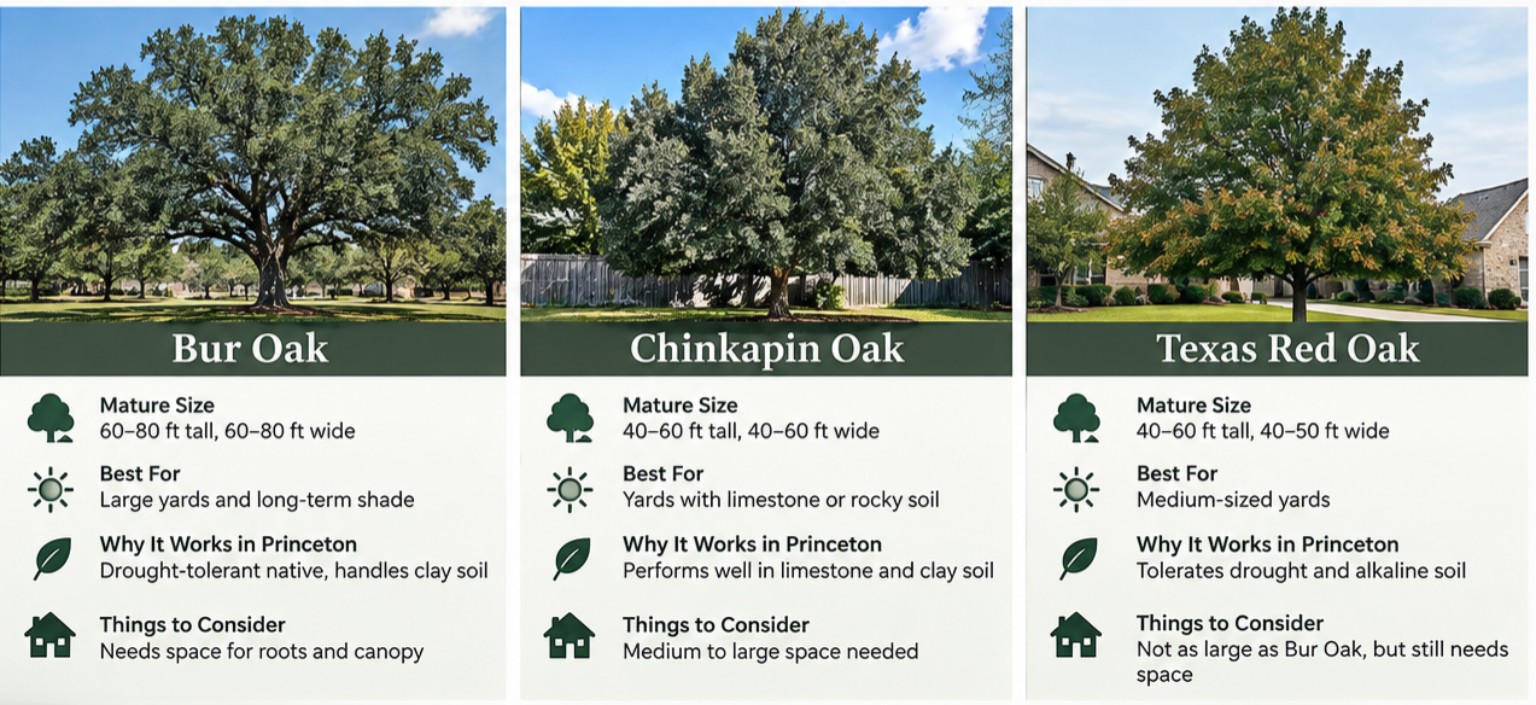
Bur Oak is a strong large-tree option. Texas A&M lists it for Collin County and describes it as a drought-tolerant Texas native. For homeowners researching Bur Oak in North Texas, the main consideration is space. Its mature canopy and roots need room.
Chinkapin Oak is relevant to Princeton because Texas A&M notes that it performs well in limestone soils and can develop into an excellent shade tree. That makes it worth considering where clay soil includes the white limestone common around the city.
Texas Red Oak is a medium-sized native option recommended for Collin County. It tolerates drought and alkaline soil, which can suit homeowners who want an oak without the eventual size of a Bur Oak.
Which Oak Is Better for a Princeton Yard?
There is no single oak for every property. Bur Oak makes more sense where there is room for a large shade tree. Chinkapin Oak deserves attention where limestone is part of the site. Texas Red Oak may suit a medium-sized yard better.
Before planting, check overhead lines, foundations, driveways and the space available for the mature tree.
Planting Trees in Clay Soil
When planting trees in clay soil, depth matters. Texas A&M recommends keeping the root collar flush with or slightly above the natural ground level and backfilling with the soil removed from the planting hole.
Princeton clay can take time to absorb water, so more watering is not automatically better. Monitor moisture around the root ball and surrounding soil rather than keeping the planting area continuously wet.